Since the mid-eighties, when RDS started to be implemented, most multimedia applications and standards have been created or significantly redefined.
Hardware has become extremely powerful with dedicated software and middleware. In those days, the internet and its protocols did not exist. Navigation systems became affordable in the late nineties, and a full range of attractive smartphones exists now. The computing power of these new products can be compared with that of mainframe installations from that era.
Listener expectations have grown faster than the technology. Visual experience is very important, including the internet look and feel. Scrolling text or delivering just audio is now perceived as insufficient for FM radio, specifically for smartphone users. New types of radio receivers with added-value features are therefore required. RDS has proven so far to be very successful.
FM radio with RDS is an analogue-digital hybrid system, which is still a valid data transmission technology, and only the applications need adaptation. Now the time has come to solve the only disadvantage: the lack of sufficient data capacity. With RDS2, the need to increase the data capacity can be fulfilled.
RDS was introduced in the early eighties. During the introductory phase in Europe, the car industry became very involved and that was the start of an extremely successful roll-out. Shortly afterwards RDS (RBDS) was launched in the USA.
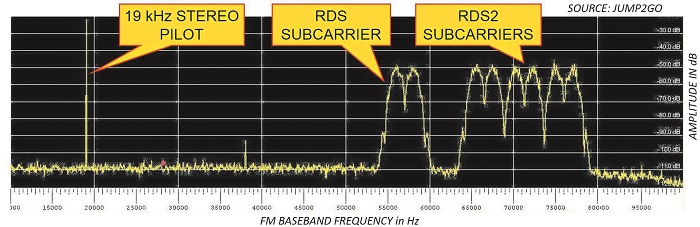
The only disadvantage of RDS so far was the limited data capacity. A solution has been investigated by the RDS Forum. For RDS2, both sidebands around the RDS 57 kHz subcarrier can be repeated a few times, up to three, centred on additional subcarriers higher up in the FM multiplex while still remaining compatible with the ITU Recommendations.
The core elements of RDS2 are the additional subcarriers, which enable a significant increase of RDS data capacity, and a newly defined group type C for the additional data streams.